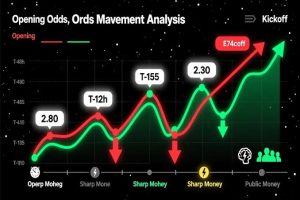
Soccer Odds kèo bóng đá Analysis: Expert Tips and Betting Strategies is the process of interpreting betting prices, estimating how likely an outcome is, and deciding whether the odds offer reasonable value. It is not a way to guarantee wins: soccer is unpredictable, and even well-researched bets can lose. A sound approach combines probability, team and match research, disciplined bankroll management, and responsible betting habits.
Understanding Soccer Odds
Soccer odds express a bookmaker’s price for a possible result, such as a home win, draw, or away win. They also reflect the bookmaker’s assessment of likelihood and include a margin that helps the bookmaker make a profit. Learning to translate odds into probability is a useful first step in judging a market.
Decimal odds and implied probability
Decimal odds are common in many regions. To calculate the implied probability, divide 1 by the decimal odds and multiply by 100. For example, odds of 2.00 imply a probability of 50% before accounting for the bookmaker’s margin. Odds of 4.00 imply 25%. These figures are not necessarily accurate predictions; they show the probability suggested by the price.
When prices are shown in fractional or American formats, convert them to a familiar format before comparing markets. The key is consistency: compare the same outcome, market, and settlement rules. A “home win” market is not the same as a draw-no-bet selection, which returns the stake if the match ends level.
The bookmaker’s margin
In a three-way match market, the implied probabilities for home win, draw, and away win usually add up to more than 100%. The excess is commonly called the overround or bookmaker margin. It means that the displayed prices are not a neutral forecast. Comparing odds across reputable bookmakers can help identify a better price, but always check that the market and terms match.
A Practical Method for Analyzing a Match
A repeatable process reduces impulsive decisions and makes it easier to review your reasoning later. Begin with the market and the match information, then estimate probability independently rather than relying only on the bookmaker’s favorite.
Step-by-step analysis
- Choose a specific market. Decide whether you are assessing the match result, total goals, both teams to score, or another clearly defined market. Avoid switching markets simply because one price looks attractive.
- Check the odds and calculate implied probability. Convert the price into a percentage, remembering that the bookmaker’s margin affects the displayed probability.
- Research relevant evidence. Review recent performance, home and away records, injuries, suspensions, likely lineups, rest days, and tactical matchups. Give more weight to information that is reliable and relevant to this fixture.
- Estimate your own probability. Use the evidence to judge how often the outcome might occur. Be cautious about false precision; an estimate is a reasoned judgment, not a certainty.
- Compare your estimate with the price. A potential value bet exists when your estimated probability is higher than the probability implied by the available odds, after allowing for uncertainty and the bookmaker’s margin.
- Set a stake before placing the bet. Choose an amount consistent with your budget and risk limits, and record the selection, price, and reasoning for later review.
This sequence is a framework, not a prediction machine. If crucial lineup information is unknown or your estimate depends on a strong assumption, waiting for better information—or passing on the match—may be the most rational choice.
Research that matters
Recent results can provide context, but a short winning or losing streak does not automatically reveal a team’s true strength. Consider the quality of opponents, chances created and conceded, and whether results were influenced by unusual events such as an early red card. Expected goals can be a useful measure of chance quality, but it is still an estimate and should not be treated as a guaranteed forecast.
Team news deserves careful attention. A missing central defender, goalkeeper, or primary striker may change a matchup more than the absence of a less influential player. Check credible, up-to-date sources and distinguish confirmed absences from rumors. Also consider motivation and scheduling context, while avoiding unsupported claims that a team will or will not “care” about a match.
Comparing Prices and Finding Value
Odds analysis is not only about deciding who is likely to win. It is also about deciding whether the offered price compensates for the risk. A likely outcome can be a poor bet if the odds are too short, while a less likely outcome can offer value if its price is generous enough.
A simple value example
Suppose you estimate that a particular outcome has a 55% chance of occurring. Fair decimal odds, before margin, would be about 1.82 because 1 divided by 0.55 is approximately 1.82. If a bookmaker offers 2.00, the price may look attractive relative to your estimate. But the conclusion is only as sound as the probability estimate. If your true assessment is closer to 48%, the same odds may not represent value.
Shop for the best available price among legal, reputable operators in your jurisdiction. A small odds difference can matter over many bets, but comparison should include settlement rules, limits, fees, and whether the bookmaker is properly licensed. Never select a bookmaker solely because it offers unusually high odds without checking its reliability.
Track decisions, not just results
A record of bets helps reveal whether your analysis is improving. Note the date, market, odds, stake, reasoning, and result. Review performance over a meaningful sample rather than drawing conclusions from a few wins or losses. A bet can be well-reasoned and still lose; likewise, a poor decision can win by chance. Closing-line value—whether your price was better than the market price just before kickoff—can offer one useful signal, though it does not guarantee long-term profit.
Managing Risk Responsibly
Bankroll management cannot remove risk, but it can prevent a losing run from becoming financially damaging. Treat betting money as money you can afford to lose, separate it from essential expenses, and decide in advance when to stop. Avoid borrowing, chasing losses, or increasing stakes to recover previous bets.
Keep stakes consistent
A fixed, modest stake is easier to manage than large wagers based on confidence or emotion. Some experienced bettors use a fraction of their bankroll, but no staking formula makes a weak prediction safe. Avoid complicated systems that promise recovery after losses; they can increase exposure quickly. Set deposit and time limits where available, and take a break if betting feels stressful or difficult to control.
Common Mistakes to Avoid
Overreacting to recent form, backing a favorite automatically, and relying on unsupported “sure thing” tips are frequent errors. Another is confusing a high payout with good value: long odds often reflect a low-probability outcome. Parlays can be appealing, but combining selections compounds uncertainty, and every added leg must be evaluated independently.
Be alert to confirmation bias. If you already favor a team, you may notice evidence that supports your opinion and overlook injuries, tactical problems, or a poor price. Write down the main reasons against your selection as well as the reasons for it. If the case depends on uncertain information, reduce the stake or do not bet.
Conclusion
Effective soccer odds kèo bóng đá hôm nay analysis means understanding implied probability and bookmaker margin, researching the match carefully, estimating chances independently, and comparing that estimate with available prices. A disciplined process, accurate records, and sensible stake limits are more dependable than chasing tips or trying to predict every result. No strategy removes the uncertainty of soccer, so bet only within your means and be prepared to walk away when the evidence or price is not compelling.