The Football Odds Guide tỷ lệ kèo : Compare Markets and Understand Betting Lines explains how to read the prices bookmakers offer, compare common football betting markets, and understand what a betting line implies. Odds show the potential return on a wager, but they also reflect the bookmaker’s estimate of an outcome’s likelihood and include a margin. Knowing how these elements work can help you compare prices and make more informed decisions—without guaranteeing a win.
What football odds mean
Football odds are prices attached to possible outcomes, such as a home win, a draw, or a team scoring. They indicate how much a successful bet could return and provide an estimate of the probability implied by the price. Odds are not predictions you have to accept: different bookmakers may offer different prices on the same outcome.
A betting line is the condition or threshold attached to a market. For example, a team may need to win by more than a set number of goals, or a total-goals bet may depend on whether the match finishes above or below a stated number. Always check the market rules, including how extra time, abandoned matches, and postponed fixtures are handled.
Common odds formats
Decimal odds are widely used and straightforward to calculate. Multiply your stake by the decimal price to find the potential total return, including your original stake. For example, a $10 bet at odds of 2.50 returns $25 if it wins, which includes $15 in profit.
Fractional odds, such as 3/2, show the potential profit relative to the stake: at 3/2, a $2 winning stake earns $3 profit, plus the stake returned. American odds use positive or negative numbers. A price of +150 indicates the profit from a $100 stake, while -150 shows the stake needed to make $100 profit. The exact presentation varies by sportsbook, but the underlying price is comparable.
Implied probability and bookmaker margin
To convert decimal odds into implied probability, divide 1 by the odds and multiply by 100. Decimal odds of 2.00 imply 50%; odds of 4.00 imply 25%. This is the probability suggested by the price before accounting for the bookmaker’s margin. It is not necessarily the true chance of the outcome.
In a market with several possible outcomes, add each outcome’s implied probability. If the total exceeds 100%, the excess is generally associated with the bookmaker’s margin, sometimes called the overround. This is one reason comparing prices across bookmakers matters: a better price can improve a potential return, though it does not make the outcome more certain.
Compare common football betting markets
Football markets vary in what they ask you to predict. Some focus on the match result; others involve goals, handicaps, or specific events. The table summarizes common options and what to check before placing a bet.
| Market | What you predict | Key detail to check |
| Match result (1X2) | Home win, draw, or away win | Usually based on the result after regulation time |
| Draw no bet | Which team wins, with a draw typically voiding the bet | Rules for a draw and stake return |
| Double chance | One of two outcomes: home or draw, away or draw, or either team wins | Lower odds may reflect the broader winning conditions |
| Asian handicap | A team’s result after a goal handicap is applied | Quarter-goal lines can split a stake |
| Over/under goals | Whether total goals fall above or below a listed line | Whether a push or half-win is possible |
| Both teams to score | Whether each team scores at least once | A 0–0 result loses a “yes” selection |
| Correct score | The exact final score | Typically a narrow outcome with high variance |
Match-result and draw-related markets
The 1X2 market is a familiar starting point: select the home win, draw, or away win. Its main limitation is that a draw is a separate outcome, so choosing either team to win loses if the match is level after the applicable period. Check whether the bookmaker settles this market on regulation time or includes extra time; league matches typically use regulation time, but rules can differ by competition.
Draw no bet removes the draw as a losing outcome: if the match is level, the stake is generally returned. Double chance covers two of the three 1X2 outcomes, so it offers a wider path to a winning bet but commonly comes with lower odds. These markets can be useful to compare when deciding how much risk you are willing to accept, not as a guarantee of safety.
Goal and handicap markets
Over/under markets ask whether the combined goals exceed or fall below a line, such as 2.5. Because goals are whole numbers, a 2.5 line has no exact-goal push: three or more goals wins over, while zero, one, or two wins under. A whole-number line, such as 2.0, may return the stake if the total lands exactly on the line, subject to the market rules.
Handicap markets adjust a team’s result by adding or subtracting goals for betting purposes. A team at -1 may need to win by more than one goal for a full win, while +1 gives that team a one-goal head start in the calculation. Asian handicap markets may use quarter-goal lines, which can divide a stake between two neighboring handicap outcomes. Read the settlement rules carefully before betting.
How to compare betting lines
Comparing odds is a practical way to check whether different bookmakers price the same selection differently. The market name and conditions must match: two prices are not directly comparable if one includes extra time and the other does not, or if their goal lines differ. Compare the full terms, not just the number displayed beside a selection.
Steps for comparing odds
Start by identifying the exact event, market, and line you want to assess. For instance, “over 2.5 goals” is different from “over 3.0 goals,” even if both appear under a goals section. Confirm the relevant match period and settlement conditions.
Next, compare the available prices for that identical selection. Convert them to a common format if needed, then consider the potential return for the same stake. Check whether fees, account restrictions, or changing prices affect the offer. Odds can move before kickoff, so confirm the price on the bet slip before submitting anything.
Why odds and lines move
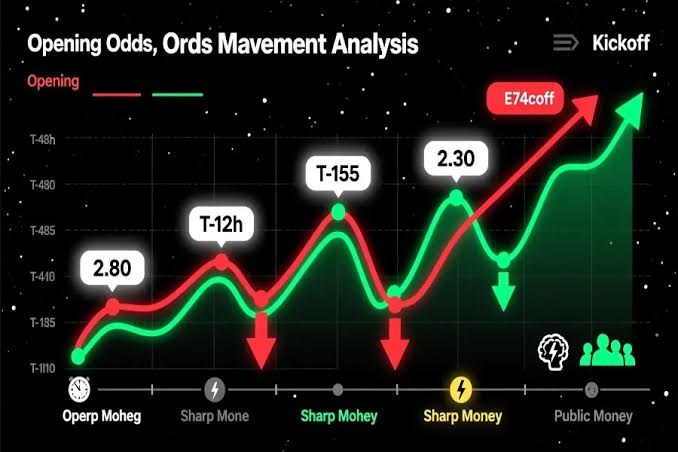
Prices may change as bookmakers respond to team news, injuries, suspensions, weather, public betting activity, or new information about a match. A handicap or goal line may also shift rather than the price alone—for example, a total could move from 2.5 to 2.75. This changes the condition of the bet, so a price comparison is meaningful only when the line is also the same.
Movement does not prove that an outcome is more likely to happen, and a popular selection is not automatically a good one. If the line changes, pause and check what the new terms mean. Avoid rushing to place a bet because a price appears to be disappearing; there is no requirement to bet on every match.
Common mistakes and safer habits
A frequent mistake is treating implied probability as certainty. Odds express a price, not a promise, and even a selection with a high implied probability can lose. Another is comparing prices without checking whether the markets use identical lines or settlement rules. Small differences in terms can materially change what counts as a win, loss, or refund.
Set a budget before betting and never stake money needed for bills, savings, or other essentials. Do not chase losses by increasing stakes, and consider taking a break if betting feels difficult to control. Betting laws and age requirements differ by location; use only legal, regulated services where you live, and seek local support if gambling is causing harm.
Conclusion
Football odds kèo nhà cái combine a price with a market condition: the format shows potential returns, while the line defines what must happen for a bet to win. Compare like-for-like markets, account for bookmaker margin, and read settlement rules before placing a wager. Match-result, goals, and handicap markets offer different trade-offs, so the appropriate option depends on your understanding and preferences. Odds can help organize information, but they cannot remove uncertainty; bet legally, set limits, and treat gambling as entertainment rather than income.