Late penalties in the Premier League no longer feel freakish. With longer stoppage times, high-intensity pressing, and fatigued defending, the final minutes now produce more decisive box incidents than in previous eras. Understanding which types of teams repeatedly win those spot-kicks requires looking beyond club names to how they attack, where they keep the ball, and how often they force desperate challenges inside the area.
Why Late Penalties Have Become More Common
Rule changes around added time and time-wasting have expanded the window for late drama. The Premier League’s push to measure every interruption more strictly has increased average stoppage time, with some fixtures now stretching comfortably beyond the 100th minute. More minutes when legs are tired and decision-making deteriorates naturally raise the odds of clumsy tackles and handballs inside the box.
At the same time, analytics show that penalties in general are being converted at historically high rates. In 2023–24, penalties occurred at roughly 0.26 per game—about one every four matches—while conversion climbed close to 90%, higher than the long-term average around 78%. Because a penalty is worth around 0.78 xG on its own, each late award behaves almost like a “free goal,” amplifying the impact of any team that can engineer them consistently in the final minutes.
Tactical Profiles of Teams Likely to Draw Late Penalties
Late penalties do not scatter randomly; they tend to gravitate toward teams that attack the box persistently. Clubs with high non-penalty xG, many box touches, and constant pressure around the penalty area are more likely to see defenders get caught on the wrong side or handle crosses under stress. In recent seasons, high-pressing, front-foot sides such as Liverpool, Chelsea, and Manchester City have consistently topped non-penalty xG rankings, indicating a broad pattern of sustained attacking presence in and around the area.
Data on penalties scored per match in 2025–26 shows how this translates into outcomes. Arsenal, Brentford, Brighton and Bournemouth each average 0.13–0.33 penalties scored per game, meaning roughly one successful penalty every three to eight matches, while several other Premier League sides sit at 0.07—about one every 14–15 games. These differences reflect not only finishing skill but also how frequently those teams reach contact-heavy zones in the box late in matches.
Mechanisms: How Playing Style Produces Late-Game Spot-Kicks
Why Certain Attacks Keep Earning Penalties in the Final Minutes
Several mechanisms connect style to late penalties. First, high territorial play in the final third during closing stages matters. Sides that maintain or even increase their field tilt and shot pressure when chasing or holding narrow leads force defenders to defend more actions in the box under fatigue, raising the likelihood of fouls or handball incidents.
Second, directness increases penalty probability. The 2025–26 tactical review notes a rise in long balls and long throws as clubs search for late goals, a trend that drives more aerial duels, second balls, and scrambled clearances around the area. Under tired conditions, these sequences often end with mis-timed challenges. Third, mental and physical fatigue under longer added-time regimes leads to slower reactions and poorer body positioning, as highlighted in analyses of the surge in injury-time goals: more late goals and dramatic penalties now occur because defenders simply spend more minutes under sustained stress.
Together, these factors mean that a team which continues to attack aggressively into added time—not one that sits back—will systematically increase its chance of drawing a late penalty over a season.
Data Signals for Teams That “Often” Get Late Penalties
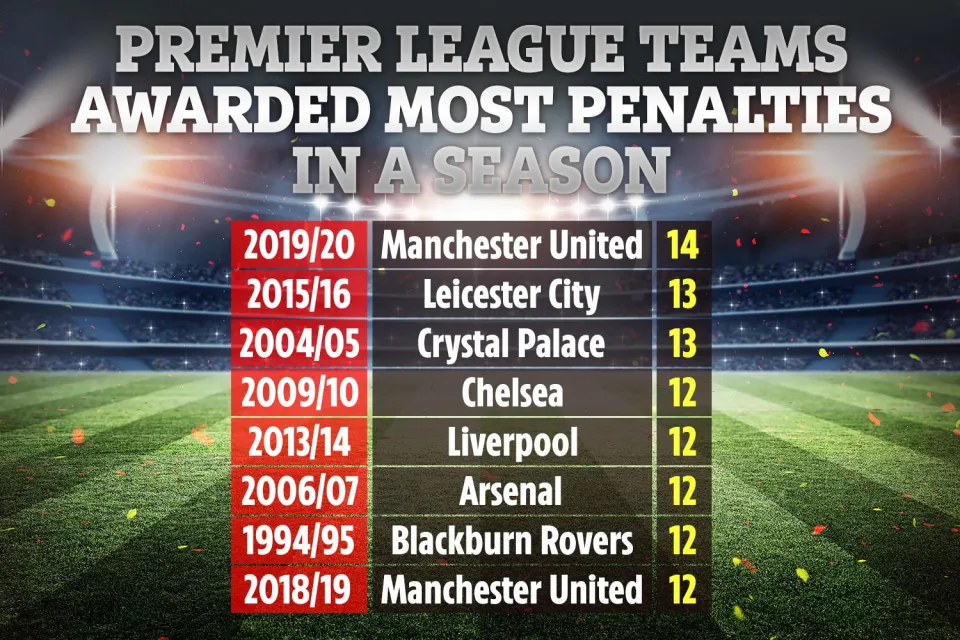
Rather than relying on anecdotes, identifying teams that reliably draw late penalties hinges on a handful of statistical signals. Penalty tables collating all awards by club across Premier League seasons show clear long-run outliers—sides like Manchester United, Liverpool, and Manchester City topping totals due to frequent box entries and long spells of pressure. When those clubs also rank high for non-penalty xG and shots inside the area, their penalty counts appear as a logical extension of their territory and chance creation.
Newer datasets add time-slicing. Injury-time goal studies point to specific matches where penalties in the 90+ minute range have swung outcomes, such as Cole Palmer’s 90+5 equaliser for Chelsea against Manchester City and Douglas Luiz’s 90+8 penalty winner for Aston Villa. League features on late drama during 2025–26 highlight champions and top contenders as “late-goal specialists,” including decisive stoppage-time penalties like Mohamed Salah’s converted spot-kick deep into added time at Burnley. While these examples are narrative-rich, they align with the wider observation that teams constantly in the opposition box when games stretch past 90 minutes are the ones that repeatedly benefit.
Odds Interpretation: Late Penalties and Match Pricing
From an odds-interpretation point of view, relying purely on the idea that a team “often gets late penalties” can be misleading. Penalties themselves remain relatively rare events, and market prices are built primarily on overall attacking strength, xG, and shot volume rather than specific expectations of stoppage-time spot-kicks. However, metrics that correlate with late penalties—high non-penalty xG, many box touches, strong field tilt, and aggressive late-game attack patterns—do inform both match odds and goal lines.
When assessing whether a team is likely to produce late drama, it is more reliable to look at how their xG and shot distribution skew by game state and time segment. Datasets combining xG, pressure, and high turnovers show that sides generating high volumes of dangerous attacks across full matches, including late on, enjoy a sustained edge in goal probability, independent of whether the eventual big chance is a penalty or open-play shot. Framing the problem this way turns “late penalties” into one visible symptom of wider dominance rather than a standalone betting angle.
Summary
Premier League teams that seem to “often” receive late penalties share common traits rather than mysterious luck. Longer stoppage times, higher conversion rates, and increased late-game attacking have combined to make penalties more influential, particularly in added time. Clubs that maintain strong territorial pressure, generate high non-penalty xG, and keep forcing duels in the box during the final minutes are structurally more likely to draw those spot-kicks, turning late penalties into the predictable by-product of style and game state rather than a purely random bonus. Looking for reliable soccer betting? ufabet เว็บแม่ is a casino known for its great payouts.